Explore vacations
Choose a Continent

Choose a Destination

Follow us:


Port environments are unforgiving. Heavy machinery moves constantly, noise makes verbal warnings useless, and workers are often focused on tasks that demand their full attention — inspections, cable work, loading operations. In this context, staying safe depends on peripheral awareness that human senses simply cannot always guarantee.
The SAFARI Connected Safety Helmet was designed precisely for that gap.
The helmet's origins trace back to an earlier European project, Interreg SPEED, where the University of Lille team embedded cameras in helmets worn by port workers to build a database of port elements for AI training purposes. The goal at the time was data collection, not safety. But spending time inside working ports, observing how operators moved and what they faced, revealed something that stayed with the team.
Ports are loud, dense, and fast-moving. Crane operators, forklift drivers, and terminal workers share tight spaces where visibility is often partial and background noise is constant. "One of the aspects that we found particularly dangerous is how little operators can see from their surroundings, and how noisy everything is," recalls Mario Sanz Lopez, the research engineer at Université de Lille now leading the helmet's development within SAFARI. The idea of building a helmet capable of detecting dangers automatically, right there on the worker's head without any external connection, was planted then. What was missing was the technology to make it work reliably in the field. The technology has since matured enough to make it real.

The helmet equips port workers with AI-powered situational awareness they wouldn't otherwise have. Cameras covering blind-spot angles feed a real-time detection system that identifies potential hazards: a forklift approaching from behind, a reach stacker rounding a corner with limited driver visibility. When a threat is detected, the helmet communicates through vibration, directly and discreetly. "A port is a tough environment for the senses, with big, noisy motors all around and potentially blinding beam lights, rain and other visually disrupting elements," Mario explains. Vibration proved to be the right channel: it works where sound and light cannot.
If the helmet detects a shock or an abnormal posture suggesting a fall or collision, it activates an emergency protocol. GPS location is captured and a distress alert is sent via an off-grid communication network to a base station, triggering an immediate response.
The design philosophy behind all of this matters as much as the technology itself. Port workers are already asked to wear a lot of protective gear, and they're not always enthusiastic about it. Introducing a helmet that continuously tracked their movements would have been a non-starter. "Every single time our team has been within a port, there is someone in charge reminding others to wear reflective jackets, safety glasses, gloves, helmets," says Mario. "Workers don't really appreciate it as they feel observed." The SAFARI helmet was built around a clear response to that reality: outside of an emergency, it transmits nothing. "If we want the solution to be deployed, it needs to be used out of will, not enforcement."
There is a broader point worth making here, one that Mario is deliberate about raising. "When we hear about AI, we tend to think of large data centers and a humongous amount of computing power," he says. The SAFARI helmet is a deliberate counter-example: intelligence that is light, mobile, and frugal, running entirely on an embedded device worn on a person's head, in a noisy industrial environment, without a cloud connection.
This is not a minor technical detail. It is a design choice with real consequences for deployment: no connectivity required, no data leaving the device during normal operations, no dependency on infrastructure that ports in remote or disrupted conditions may not have. The helmet works because it has to work on its own.
Proof of concept is one thing. Putting a prototype on real workers in a live port is another.
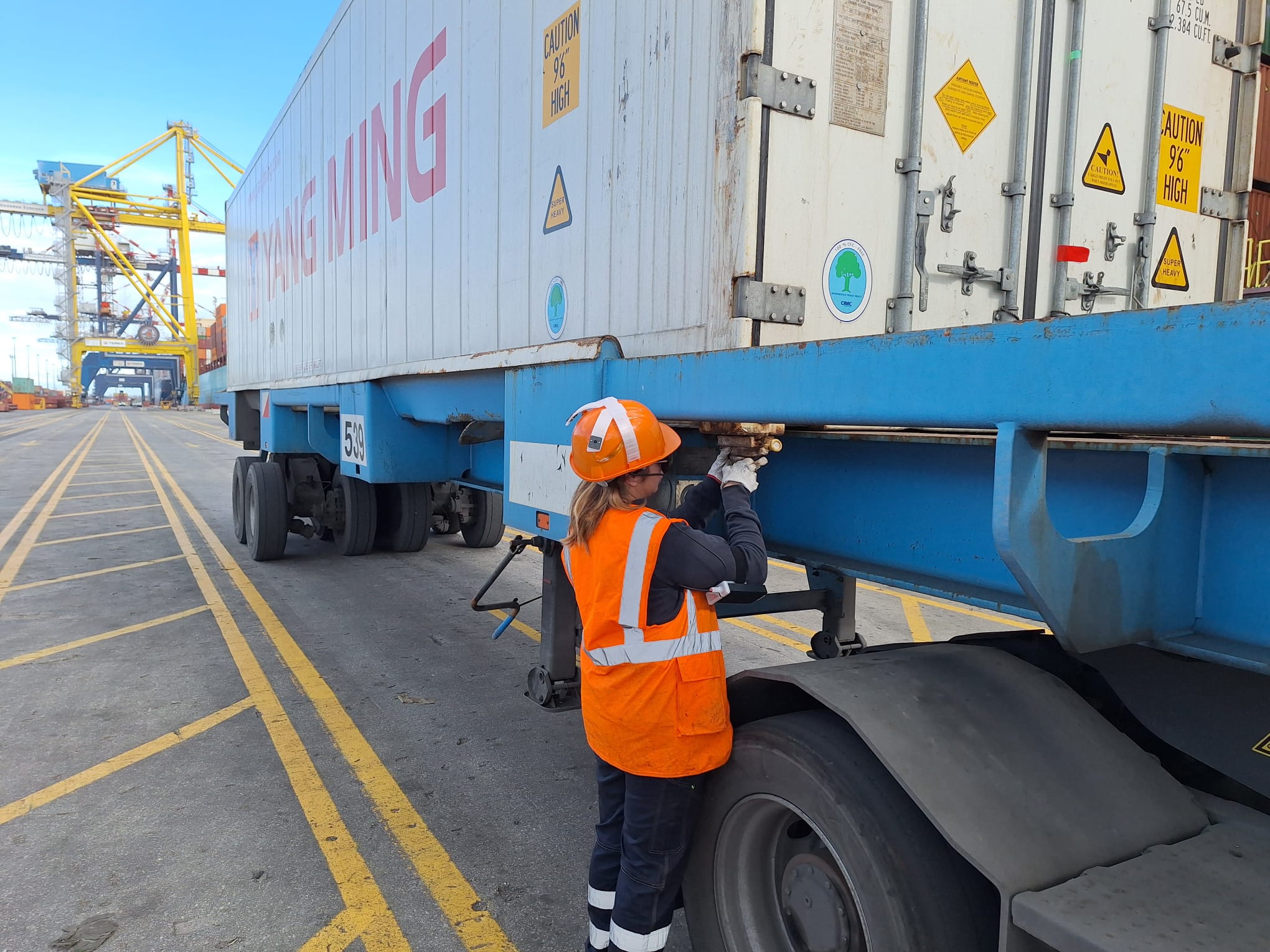
In late October 2025, the SAFARI team travelled to the Port of Livorno, one of the project's replication sites, to run the first real-world training and testing sessions. Over two days, the helmet was tested across different operational contexts: a cellulose warehouse and a container loading terminal, with operators and safety managers from three terminal companies taking part. The sessions were kept within normal working hours and did not disrupt port operations.
Operators tried the helmet, walked through simulated hazard scenarios, and gave feedback on everything from fit and comfort to whether the vibration intensity was calibrated right. The response was encouraging. The alerts registered clearly without being disruptive, and the helmet passed between users easily enough to suggest comfort was not an obstacle to adoption.
Real field conditions are the best teacher, and Livorno delivered plenty of them. Challenging light, dense radio environments, and the sheer variety of a working port all provided the team with exactly the kind of data a lab cannot generate. The sessions confirmed what worked, surfaced what needed refinement, and produced a clear development roadmap. Improvements already implemented since Livorno have nearly doubled detection performance under difficult lighting conditions.

The SAFARI Connected Safety Helmet is not a standalone gadget. It is designed to integrate with the broader SAFARI digital platform, a modular system being built to help ports anticipate, respond to, and recover from climate-related disruptions. The helmet's emergency alert system will connect to the platform's supervision layer, making real-time worker safety data part of the same operational picture as weather alerts, infrastructure monitoring, and logistics coordination.
The Livorno session was a first step. More testing, more iteration, and ultimately a solution built for deployment across port environments of different sizes and configurations. For Mario Sanz Lopez, the ambition is straightforward: "AI can be light, mobile, and most importantly, frugal. If on top of that I can manage to save a couple of lives, the effort will be worth it."

